


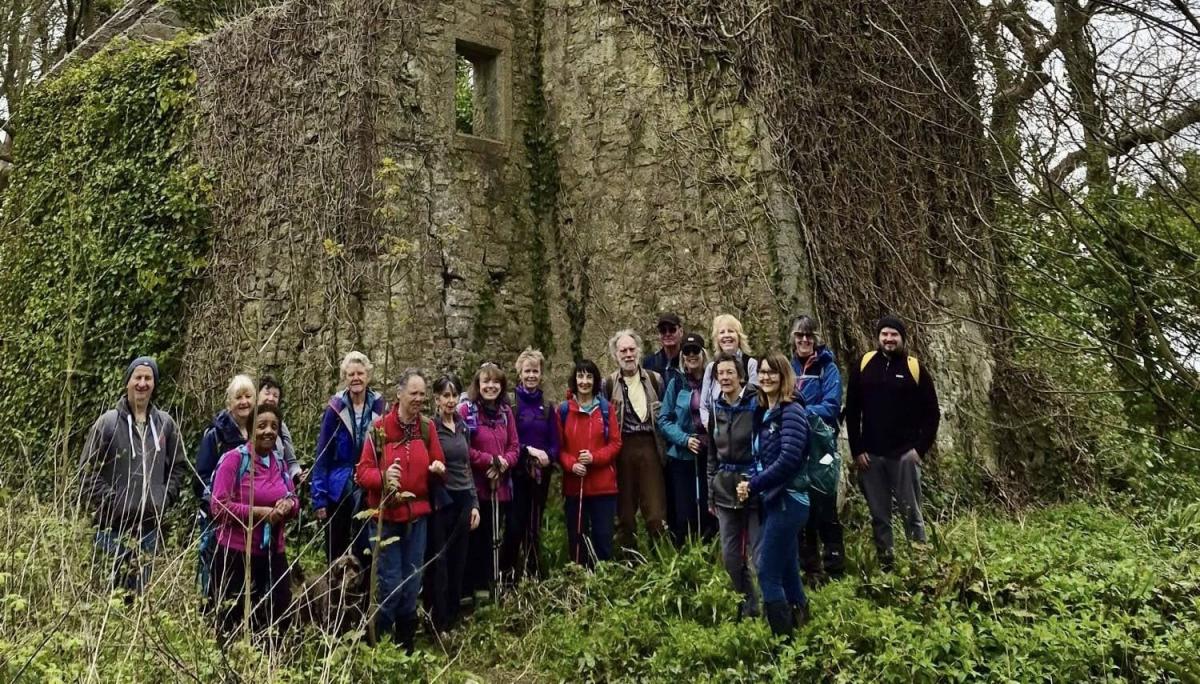
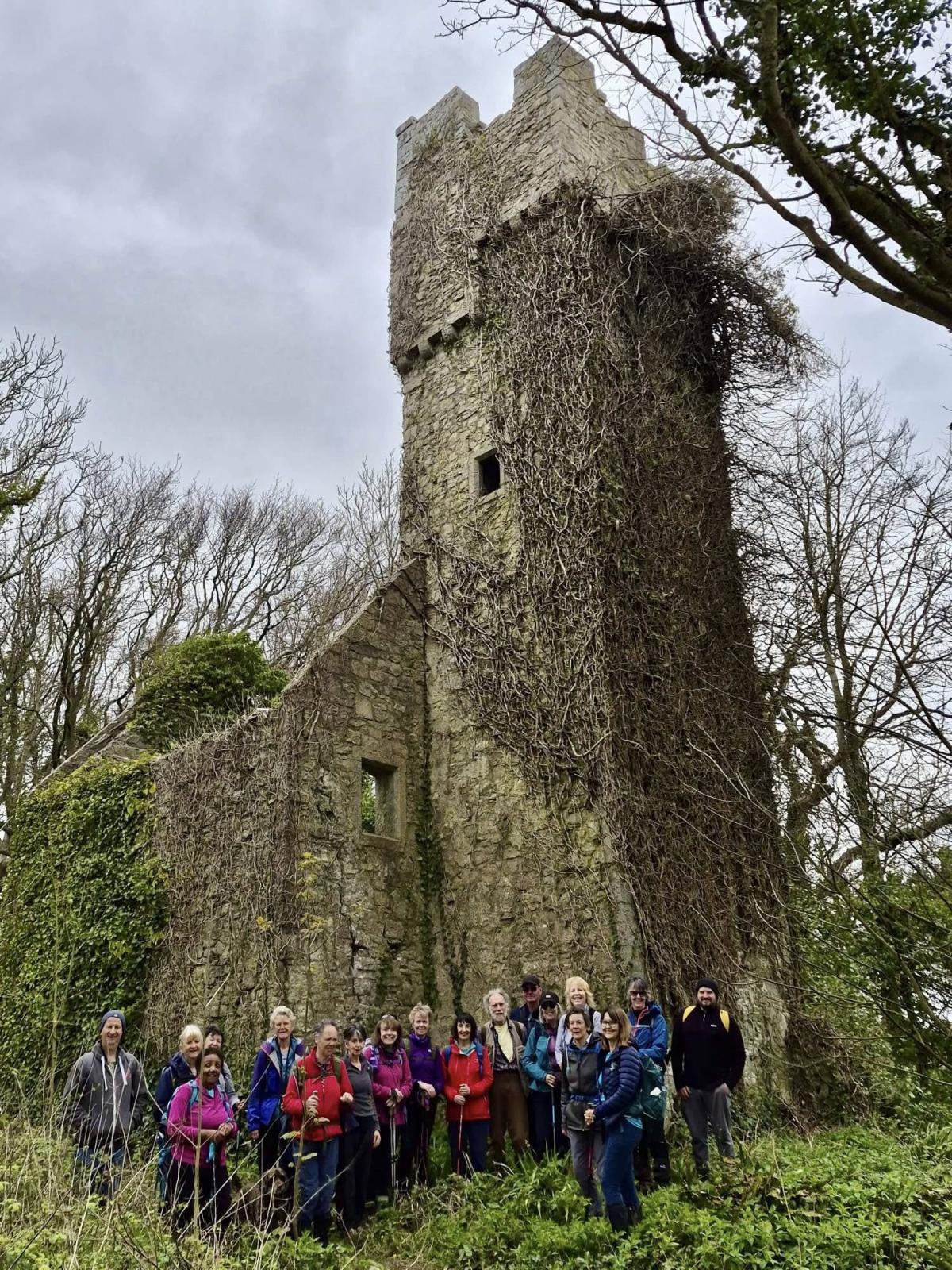

Geraint from Penarth and District Ramblers and his eighteen companions celebrated Easter Saturday with a windy walk fortunately in dry weather and some sunshine along the coast, taking in his favourite beach at Monknash in the beautiful Vale of Glamorgan.
They began from the car park at New Mill Farm and followed the quiet lane, before crossing a stile into a field and headed inland following the Nash Brook. Carefully crossing the brook on loose stepping stones, where Sam made sure everyone was safely across, they passed through the remnants of the monastic grange with the remains of one wall of its huge tithe barn and its dovecote still in situ, providing the evidence that it provided much needed farm provisions for Neath Abbey. The huge area of farmland worked by Cistercian monks during the 12th century was both productive and wealthy and its dovecote is Grade II listed.
They made their way up through the village of Broughton and by way of fields, where some lucky walkers spotted a hare bounding along, and tramping quiet lanes and meadows their journey led them to the overgrown ruins, surrounded by woodland of a tower just west of St Donat’s Castle. It was a folly tower dating back to the end of the 16th and early 17th century, built by the Stradling family who owned St Donat’s and it is believed as a watchtower to keep an eye open for Spanish or French invasions, as well as pirates in the Bristol Channel.
A bridleway led them to the small church of Saint Donat nestling below the immense castle walls. Built by the Normans in 1090 it has been a place of sacred worship since then and was named by the Norman invaders and during the centuries has been partly rebuilt with its tower being 14th century. It is Grade I listed and contains the Stradling family chapel where members of the family are interred.
They paused in fond memory of Jeff Kitch a much loved group member who passed away in March and his happiness and joy and love of walking shone through in the simple words that were spoken by various members. Jeff would always appreciate the cakes and pies that Josie made for the group’s path clearing work, and some reccies and in memory of this lovely human being, she had baked fresh scones which were soon devoured during their lunch break in the sunny churchyard whilst listening to the sound of birdsong.
Then following a wooded pathway along the edge of the valley they made for the coast and turned westwards following the cliff path as they made their way to the tall lighthouse at Nash Point. This white painted 37 metre tall lighthouse was built after the public outcry following the loss of the Frolic that was wrecked in March 1831, with the loss of 78 lives on the treacherous Nash Sands that had claimed many a vessel over the years. In just eleven months two lighthouses were erected as a guide to mariners, but during the 1920s it was decided the lower of the two towers was not needed and it was taken down in the 1950s. The last lighthouse keeper left on August 5, 1998, as Nash was the last light to be automated in Wales and now it is monitored and controlled from the Trinity House Centre in Essex.
They made their way downhill onto Monknash foreshore, carefully scrambling over rocks and huge pebbles before reaching the sand where the tide was out. With the backdrop of the impressive and dramatic tall cliffs they moved on, spotting Honeycomb Worm structures on some of the rocks on the shoreline. This worm builds its home on reefs and rocks out of sand and shell fragments which resembles a honeycomb, hence the name, and each worm has its own compartment with the worm feeding on particles in the sea when the tide comes in and to preserve them, they are best avoided and not walked upon as they are fragile.
Reaching the Nash Brook as it bubbled and tumbled its way across the rocky foreshore on its way to the sea, they recrossed the brook and turning inland followed the uneven path up through Cwm Nash and returned to their start point after a glorious 7.5 mile spring walk.
You can follow the group on www.penarthramblers.wordpress.com or on Facebook.


Share