


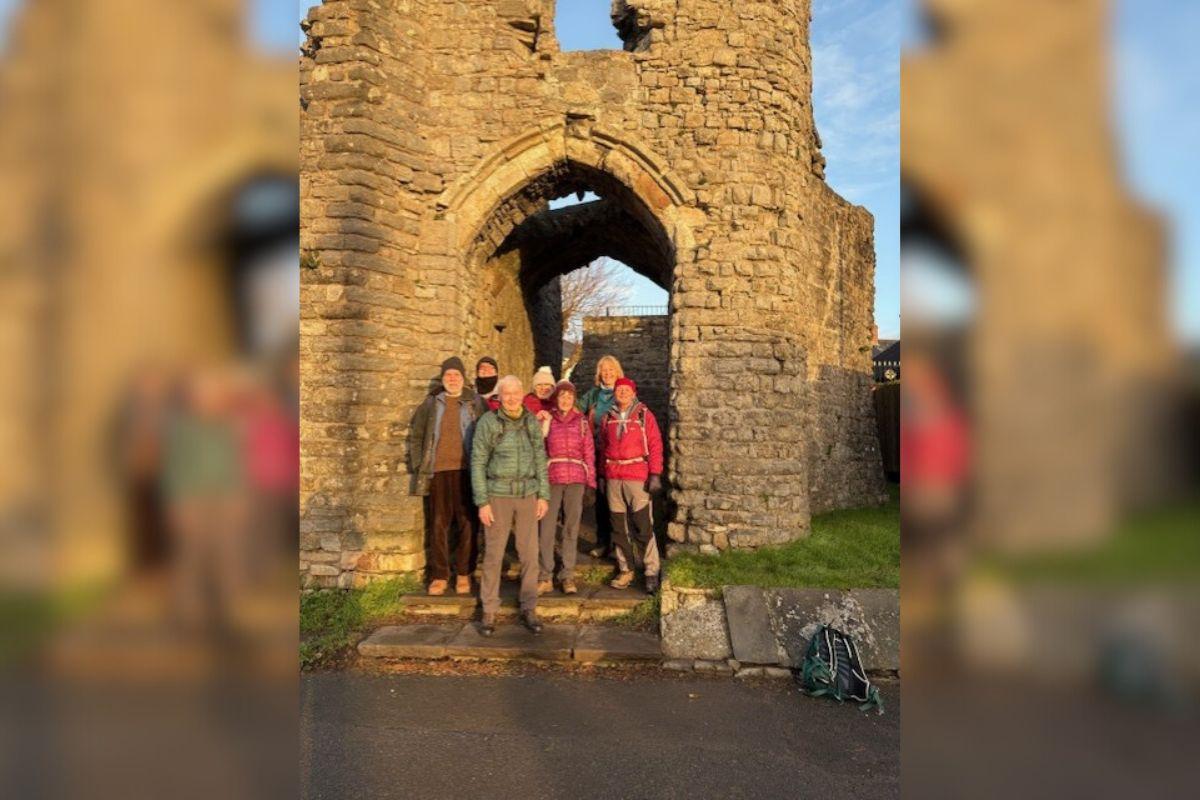
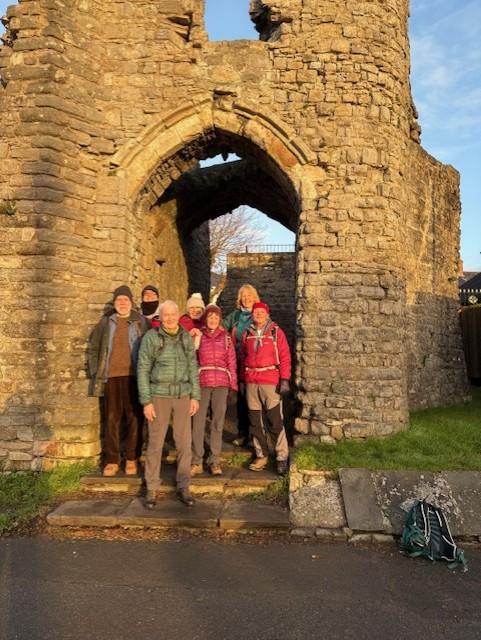

With the coming of the fresh new year, William from Penarth and District Ramblers laced up his boots for his annual trek to the Blue Anchor Inn at East Aberthaw for lunch half way around, and a group of six eager walkers joined him at the ruins of Barry Castle on a lovely bright sunny morning.
Setting off by pavement and joining the footpath above Cliff Wood to follow the rutted and exposed tree-rooted path above the pebble beach below the tall cliffs, the Golden Stairs led them steeply downhill into Porthkerry Country Park. Porthkerry is believed to derive its name from the ‘Port of Ceri’ an early Welsh prince who berthed his massive fleet of ships in the shelter of the bay.
The fairly high tide meant waves crashing onto the pebbles as they climbed the steep muddy path into the open field marking the site of the Bulwarks. This Iron Age hillfort is bounded by the sea on the south side and deep ditches protected its western perimeter, the remains of which are still visible in the surrounding trees. Onward through Porthkerry Leisure Park whilst gazing across the Bristol Channel spotting the well-known landmarks of Brean Down, Hinkley Point Power Station, the Quantock Hills and Exmoor with its highest point of Dunkery Beacon.
The open cliff pathway led them past the southernmost tip of mainland Wales, which is marked with a huge lump of stone quarried in North Wales and past the old flooded limestone quarries, to continue along the Wales Coast Path to Fontygary Bay and a quick stop for refreshments. On through the deserted Fontygary Leisure Park and down the refurbished steep cliff steps to the overlook the salt lagoons where the River Thaw once flowed before being re-routed when Aberthaw Power Station was built.
Steps led them across the sturdy sea wall built to protect the land from the sea and along the path past the old Limeworks that opened in 1888 and stands as a sentinel guarding the lake in the Nature Reserve, before passing through the railway tunnel and up Well Road to the Blue Anchor Inn. Leaving muddy boots outside and entering the warm and welcoming atmosphere of the pub, three members in the shape of Barrie, Jeff and Terry joined them for lunch and after a delightful, as always lunch, and some liquid refreshment it was time to bid farewell to friends and don boots, with a quick photo to mark the occasion taken by a customer in order to continue their journey.
The lane at Port Road led them past the huge Aberthaw Limestone Quarries and through the quiet hamlet of Nurston before heading along an old bridleway, over a gate and through a field to the perimeter of Cardiff Airport and past the defunct village pump in Rhoose to tramp Station Road southwards to the railway crossing.
Following the rough tracks through the landscaped remains on the site of the old cement and asbestos works to rejoin the coast path they made their way by road to Porthkerry village for a visit to the pretty Church of St Curig. This 7th century Bishop came to Wales in the latter part of the Roman occupation and allegedly carried a jewelled staff which had healing powers. This church was restored in 1867 when its original thatched roof was replaced and its organ and lych gate are a memorial to those lost in the Great War.
After paying their respects to the poignant gravestone dedicated to a drowned seaman dated 1868, it was downhill past Church Farm on a narrow track to overlook the imposing Porthkerry Viaduct This impressive construction across the valley is 110 feet in height and in January 1898 was damaged by subsidence, when the strong tides caused the footings of the base of a pillar to shift, but it reopened in 1900. Then across the main meadow in Porthkerry Country Park and up Lover’s Lane past the remains of Cliffwood Cottage, before heading back along pavements to their start point.
You can follow the group on www.penarthramblers.wordpress.com or on Facebook.


Share